

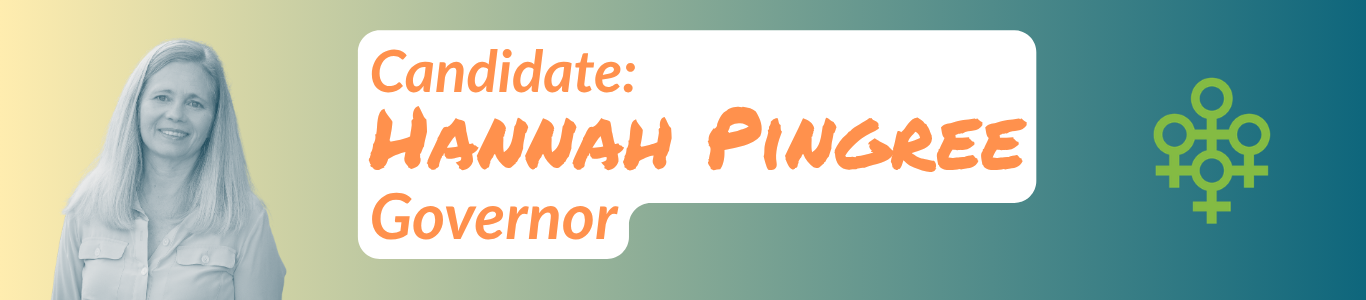
Highlights from our conversation on April 1, 2026
Building care infrastructure and economic equity
What are your top policy priorities to address the barriers and challenges facing the care work industry (child care, elder care and health care) and systemically undervalued and underpaid care workers, 80% of whom are women?
“Medicaid reimbursement rates do drive a lot of the funding of folks in the care industry and our ability to ensure livable wages for folks who are providing the services that are paid for by Medicaid. That is something that the governor has the ability to work with the legislature on, and it's just about a budget funding priority issue, and again, with a lot of healthcare needs in our state and a large rural state, it's a challenge, but Medicaid reimbursement rates are significant issues for early childhood and children.”
What types of new or ongoing interventions do you support to address disparities in unpaid and informal care work which often forces women out of the workforce, limiting health insurance, social security benefits, and retirement savings?
“We are in this time of just tremendous income disparity, and we are facing so much…such a loss of federal funds for SNAP and Medicaid, you know, while people in Maine are feeling especially stressed, so the next governor is going to need to come in to consider how do we shore up those services that people most rely on? And, you know, I think part of the structural challenge is how do we ensure that people have access to decent wages, and that we also have a taxation system in the state of Maine that places less burden on middle- and low-income families, and asks the wealthiest to pay more… I think it's going to be pretty incumbent on the next governor to ensure that we find ways to pay for the basic safety net for Maine families, and it especially hits older folks who are living on fixed incomes, or younger families the most.”
“That is something that the governor has the ability to work with the legislature on, and it's just about a budget funding priority issue...”
“I think it's going to be pretty incumbent on the next governor to ensure that we find ways to pay for the basic safety net for Maine families.”
Ensuring reproductive and gender-specific healthcare
What are your top policy priorities to address the barriers to accessing consistent, high-quality perinatal care given the rapid closure of birthing units, especially in rural areas?
“We lack a reimbursement model that really incentivizes that kind of care, and I think it's not dissimilar from prioritizing the ability to take care of children and give birth in certain parts of our state, and it is about reimbursement models, but also the creativity of our healthcare system planning. Maine's healthcare system is not very planned. It just sort of… it grew up in a piecemeal way, and it's now been consolidated, and now there's contraction in the sort of people and funding, and now it's just, like, starting to fall apart.”
“We lack a reimbursement model that really incentivizes that kind of care.”
Ending gender-based and carceral violence
What policy solutions do you support to address gun violence in our state, and the disproportionate impact on women and gender-minorities?
“I've had the opportunity over the last almost 7 years in state government to spend a lot of time thinking about how do you actually bring people together to solve challenges. The challenges we face on gun violence are often, you know, you have mental health providers and a criminal justice system, and then public safety systems that don't always communicate very well… So much of the violence in Maine is involving domestic violence… How do we bring people together to think about how to save more lives for this interfamily violence that we see so often in Maine?”
“I've had the opportunity over the last almost 7 years in state government to spend a lot of time thinking about how do you actually bring people together to solve challenges.”
Developing equitable & accessible government systems
What policies or approaches would you support to ensure all eligible voters can participate in elections, and that people who want to run for office are able to do so?
“I started running when I was 25, and I was elected when I was 26 and ran under a clean election system… I was one of the only young people, and one of the only young women in the Maine legislature. When I was elected Speaker in 2008, we had a record number of women, and also people of multi-ages and many more people who had jobs as teachers and everything else, so that's always been incredibly important to me.”
“I started running when I was 25, and I was elected when I was 26 and ran under a clean election system.”
Other notable quotes
“I have spent my career in public service since I was 26 years old in the Maine Legislature, and chaired the Health and Human Services Committee many years ago, but for almost the last 7 years, have, led the Governor's Office of Policy, Innovation, and the Future for the Mills administration, working on issues like starting the cabinet on Aging. We also restarted the Children's Cabinet, and I will say, through all of those experiences, learned, very personally and firsthand just the challenges that folks who work in the care industry have.”
“I launched my campaign talking about the issue of housing affordability, because I think it is just so important that we tackle this challenge, because the ability for younger families to settle in Maine, but also, older residents to be able to find access to housing that they can actually afford. It is so crucial to our ability to solve any other problem in the state of Maine. And so, I won't give you all the gruesome details, but we put out a pretty bold housing affordability plan that is about investing in more housing supply, helping people stay in their homes.”
Each profile features direct quotes pulled from candidate’s answers to our questions. Full transcripts of each conversation can be found by clicking here.