

You Work Hard
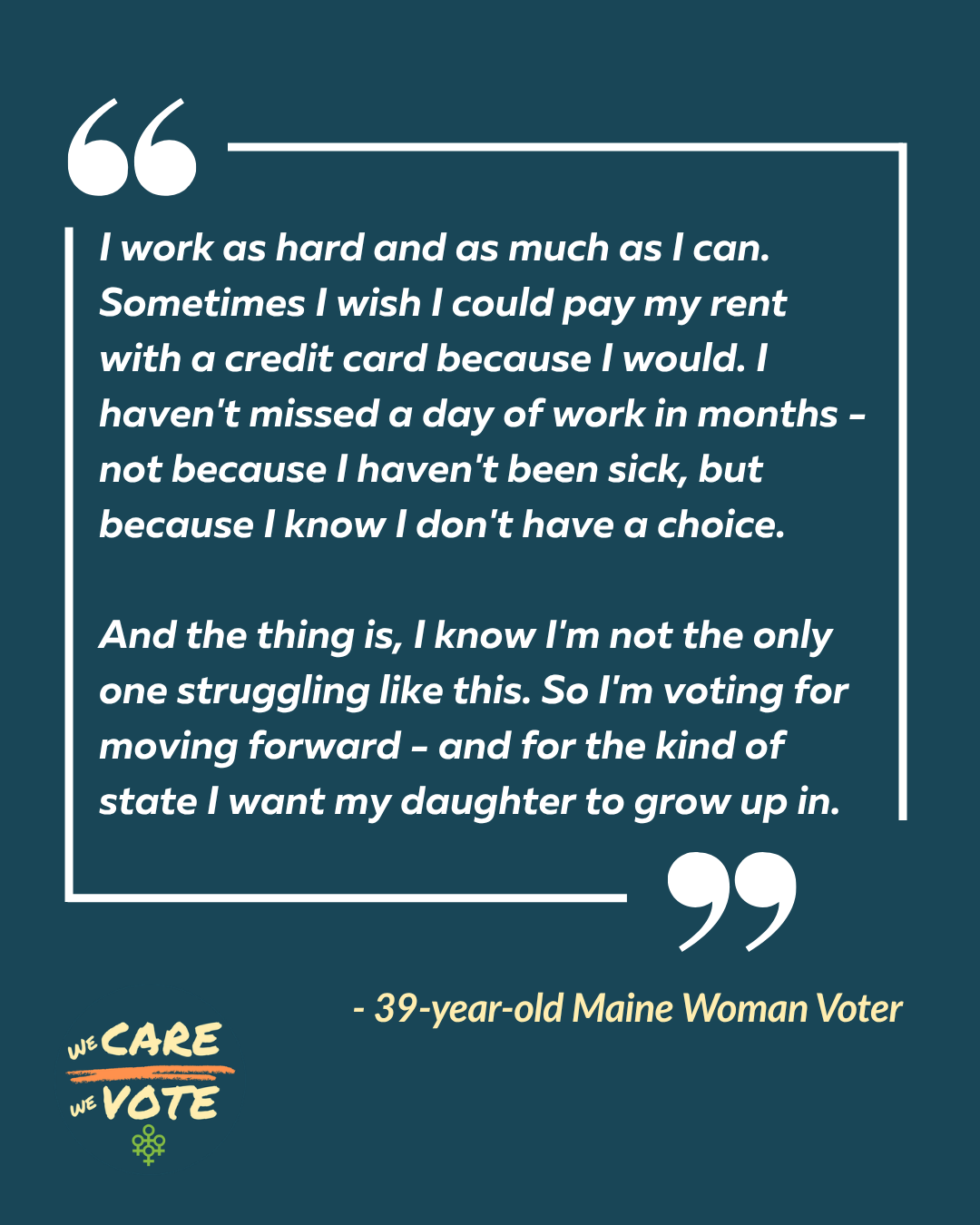
Sometimes you feel like you can’t work any harder - and then you do . Because it’s who you are.
In the last two years, the President and Congress have made radical changes that undermine every aspect of our public infrastructure - from cuts to family planning, to halting promised payments to sexual and domestic violence services, to stripping discrimination protections within the federal government.
This November, we have the opportunity to elect candidates that will help protect Mainers from Federal overreach, and fight for gender equity on every front in Washington, D.C.
We Care About the Issues
Click below to learn more about the issues affecting Maine Women this election season
-
Professional care work industries in Maine, including child care, elder care and health care, are women-led. Over 80% of all direct care workers in Maine are women, who are systemically undervalued and underpaid.
Women in Maine also provide the vast majority of unpaid and informal care work for their families and are more likely to work part-time or leave the workforce to do so. This limits their ability to access health insurance or save for retirement and reduces Social Security benefits in later life - which means women in Maine enter their older years at twice the rates of poverty than men.
While Maine’s Paid Family and Medical Leave program now ensures almost every worker in Maine has access to paid time to care when they need it most, the US continues to be the only country in the developed world without PFML, and the program faces persistent threats in the Maine Legislature. Time to care matters, and we should have to fight for a program we already won.
-
Access to consistent, high-quality perinatal care is a key factor in positive perinatal health outcomes. However, Maine is experiencing a perinatal and maternal health care crisis: Over the last decade, Maine has seen the closure of more than 10 Labor and Delivery units - four in the last year alone – the majority of which are in rural areas.
Recent targeted funding cuts to Title 10 have significantly impacted our fragile statewide family planning infrastructure which serves 30,000 Mainers every year. Many rural women rely on these clinics for full spectrum and primary health care services which provide birth control and abortion care as well as cancer screenings and mammograms.
-
The statewide network of sexual assault and domestic violence victim/survivor support services are a critical public health response to addressing trauma experienced by nearly a third of all women in Maine. This is another women-led workforce that is increasingly precarious due to historical underfunding by the state and recent federal cuts.
Women and gender-minorities bear a disproportionate impact of gun violence, including suicide by gun and intimate partner violence.
-
While Maine has important protections embedded in the Maine Human Rights Act, neither the United States’ or Maine’s Constitutions protect people from discrimination based on sex and gender, and there are ongoing attempts to roll back these protections for Mainers.
March 26, 2026 was National Equal Pay Day, symbolizing how far into the year women in the United States must have worked to earn what men had earned by December 31, 2025. According to the United States Census Bureau, the difference between median earnings for men and women in Maine who work full-time, year-round is nearly $9,000.